
Two-Plane Four-Point Rotor Balancing Calculator (No-Phase Method)
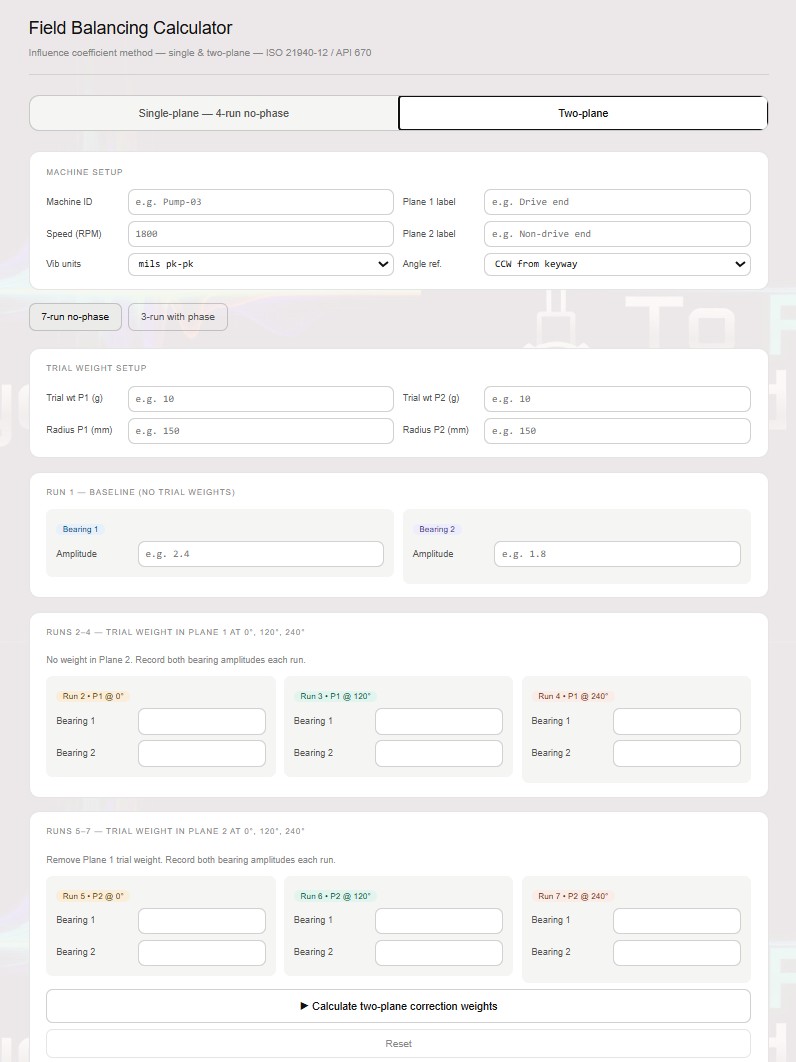
This tool implements a two-plane, four-point rotor balancing procedure without explicit phase measurement, designed for practical field applications where phase instrumentation is unavailable or unreliable. The method is commonly used in industrial rotor dynamics, maintenance engineering, and vibration correction scenarios where only amplitude-based measurements can be obtained at discrete reference points.
The algorithm is based on a deterministic influence matrix approach, where vibration responses are recorded at four measurement positions under controlled trial mass conditions. These amplitude-only readings are used to construct a system of linear equations that describe the relationship between applied unbalance and observed vibration magnitude across two correction planes.
By eliminating the requirement for phase data, the method relies on relative amplitude variation and positional indexing to infer directional imbalance characteristics. The resulting system is solved simultaneously to determine the optimal correction masses in both balancing planes that minimize residual vibration.
Methodological Principle
The system assumes linear superposition of vibration response and models the rotor as a coupled two-plane system. Each trial condition produces a unique amplitude response signature, which is used to populate an influence matrix. The final correction solution is obtained through matrix inversion or least-squares minimization, depending on system conditioning.
Key Computational Features
- Two-plane balancing formulation (dual correction planes)
- Four-point amplitude-based measurement input
- No requirement for phase angle instrumentation
- Influence matrix construction from trial mass response data
- Simultaneous solution for optimal correction weights in both planes
- Minimization of resultant vibration magnitude across measurement points
Assumptions and Limitations
This approach assumes:
- Linear and time-invariant rotor response
- Negligible nonlinear coupling between measurement points beyond modeled interactions
- Sufficient excitation from trial mass to produce measurable amplitude variation
- Stable operating conditions during data acquisition
Applications
The method is suitable for:
- Industrial rotor field balancing without phase probes
- Maintenance of large rotating machinery (fans, pumps, turbines)
- Situations with limited instrumentation access
- Engineering diagnostics where only amplitude data is available
- Educational demonstrations of inverse problem solving in rotor dynamics