
Vector Balancing Calculator
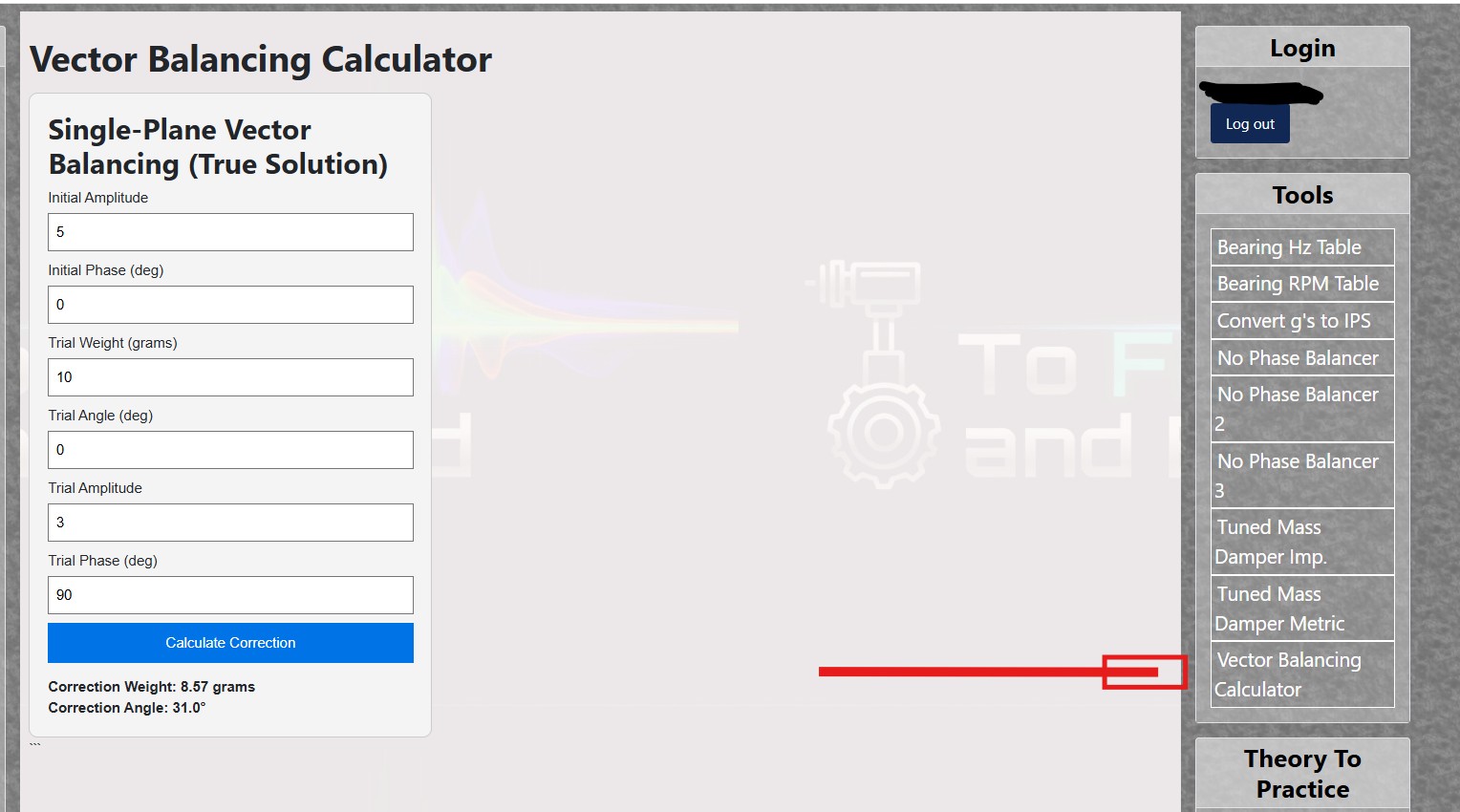
Single-Plane Rotor Vector Balancing Using the Influence Coefficient Method
This computational tool implements a single-plane rotor balancing procedure based on the influence coefficient method, commonly employed in experimental rotor dynamics and vibration correction analysis. The formulation assumes a linear system response and represents measured vibration states as complex vectors in a two-dimensional rotational plane, defined by amplitude and phase parameters.
The method operates by first transforming the baseline and trial condition measurements from polar form into complex Cartesian components. A controlled trial mass is then introduced, and the resulting change in system response is used to determine the influence coefficient, representing the proportional relationship between applied unbalance and observed vibration response.
Under the assumption of linear superposition, the required balancing correction is obtained by solving for the vector that counteracts the initial unbalance when scaled by the computed influence coefficient. The final correction is expressed in polar form, providing both magnitude (mass) and angular position for practical implementation.
Methodological Summary
Let the initial vibration state and trial response be represented as complex vectors in the form of rotating phasors. The difference between these states defines the system response to a known trial mass, from which the influence coefficient is derived. The correction vector is subsequently obtained through inversion of this relationship, yielding the required balancing solution in a single measurement plane.
Scope and Assumptions
This formulation is restricted to single-plane balancing scenarios, where the system dynamics are dominated by planar vibration modes. It assumes:
- Linear system behavior within the operating range
- Time-invariant response characteristics
- Negligible cross-plane coupling effects
Applications
The implementation is applicable to:
- Rotor dynamic balancing in experimental setups
- Vibration correction in rotating machinery
- Laboratory-based modal and response characterization
- Educational demonstration of influence coefficient techniques in mechanical engineering