
Tuned Mass Damper (Dynamic Vibration Absorber)
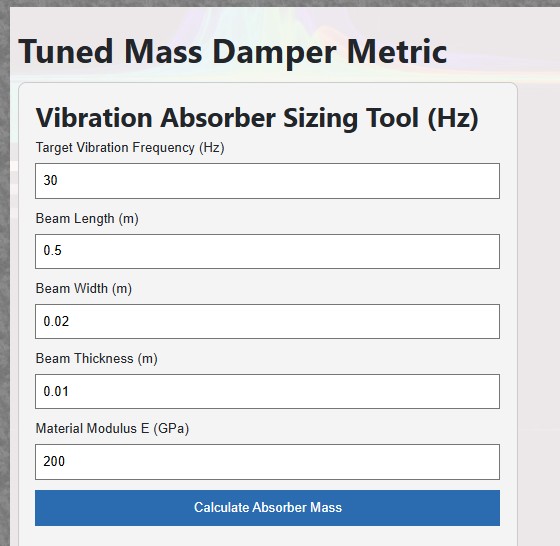
A tuned mass damper (TMD), also referred to as a dynamic vibration absorber, is a mechanical device used to reduce or eliminate excessive vibration in structures and rotating equipment. It consists of a secondary mass attached to the primary system through a flexible element (typically a beam or spring), forming a secondary oscillating system.
The absorber is designed such that its natural frequency closely matches the dominant excitation frequency of the vibrating system. When properly tuned, the absorber introduces a counteracting dynamic force that transfers vibrational energy away from the primary structure, thereby reducing its amplitude of motion.
The fundamental tuning relationship is based on matching the absorber’s natural frequency to the excitation frequency:
fₙ = (1 / 2π) √(k / m)
Where:
- fₙ = natural frequency of the absorber
- k = stiffness of the supporting beam or spring
- m = absorber mass
When the absorber is correctly tuned, the system behaves as a coupled two-degree-of-freedom system, resulting in a significant reduction in vibration at the target frequency. Energy is not eliminated but redistributed, typically producing two smaller peaks on either side of the original resonance.
Practical Application in Industrial Piping Systems
Tuned mass dampers are commonly used in piping systems, structural members, and machinery where resonance or steady-state vibration occurs at a known frequency, such as running speed (1× RPM) or a dominant harmonic.
In a typical field application, a cantilever beam is rigidly attached to a vibrating pipe or structure, and a calculated mass is mounted at the free end of the beam. The beam provides the required stiffness, while the attached mass is selected to tune the absorber to the measured vibration frequency.
Implementation Steps:
- Measure the dominant vibration frequency
Using vibration analysis equipment, identify the primary excitation frequency (e.g., 1800 CPM / RPM). - Select absorber geometry
Choose a beam length and cross-section that provides a practical stiffness range based on available space and mounting conditions. - Calculate required absorber mass
Using the beam stiffness and target frequency, determine the mass required to tune the absorber. - Install the absorber assembly
Attach the beam rigidly to the structure using clamps or welded connections. Secure the mass at the free end using bolted or clamped connections to ensure minimal relative motion. - Field tuning and verification
After installation, measure the vibration response. Fine adjustments to the mass may be required to achieve optimal reduction due to uncertainties in system stiffness and boundary conditions.
Typical Use Cases
- Mitigation of pipe vibration caused by flow-induced excitation or mechanical resonance
- Reduction of structural vibration in platforms, supports, and frames
- Suppression of resonance in rotating equipment operating at constant speed
- Correction of localized vibration issues where redesign or stiffening is impractical
Key Considerations
- The absorber must be tuned to the correct frequency; even small deviations can reduce effectiveness
- Attachment stiffness is critical; loose or compliant connections will detune the system
- The method is most effective for single-frequency or narrow-band vibration problems
- Periodic inspection is recommended to ensure the integrity of bolted or clamped connections
This method provides a cost-effective and practical solution for vibration mitigation, particularly in field conditions where structural modification or system redesign is not feasible.