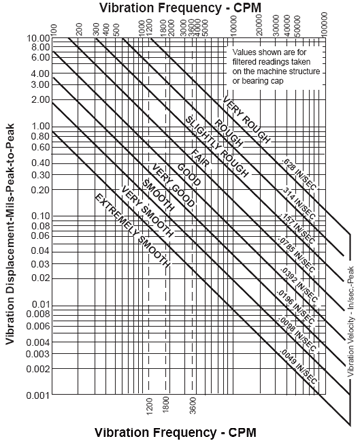
Acceleration-Velocity Crossover at 0.5g
This comes down to the frequency-dependent sensitivity of each measurement parameter and where they provide the best signal-to-noise ratio.
The Physics of the Crossover
For a sinusoidal vibration signal, the three parameters are mathematically related by frequency:
- Velocity = Acceleration / ω (where ω = 2πf)
- Displacement = Velocity / ω = Acceleration / ω²
This means acceleration emphasizes high frequencies, velocity is relatively flat across mid-range, and displacement emphasizes low frequencies.
Why 0.5g Specifically?
At approximately 0.5g (around 10 Hz), a practical crossover occurs:
| Below ~10 Hz | Above ~10 Hz |
|---|---|
| Acceleration signal is weak/noisy | Acceleration signal is strong |
| Velocity gives better resolution | Acceleration captures high-f faults better |
| Displacement is often the best metric | Displacement becomes too small to measure usefully |
At 0.5g, the acceleration amplitude is just sufficient to produce a velocity reading that sits comfortably in the typical velocity measurement range of industrial machinery (~0.1–25 mm/s RMS). Below this, velocity derived from acceleration integration becomes dominated by integration drift and low-frequency noise.
The Integration Problem
When you integrate acceleration to get velocity:
- Integration amplifies low-frequency noise (1/f characteristic)
- Below 0.5g at low frequencies, the noise floor of the accelerometer swamps the actual signal
- The integrated velocity value becomes unreliable, not because the physics breaks down, but because the sensor math breaks down
Practical Standards Alignment
This crossover also aligns with common machinery standards (ISO 10816 / ISO 20816):
- 2–10 Hz zone → displacement is king (large slow machines, shaft motion)
- 10–1000 Hz zone → velocity is the standard (most rotating machinery faults)
- >1000 Hz zone → acceleration dominates (bearing defects, gear mesh, blade pass)
The 0.5g level at ~10 Hz marks roughly where the energy content of typical machinery faults shifts from being better expressed in mm/s to g's.
Rule of Thumb Summary
< 10 Hz → Use Displacement (µm or mils) 10–1000 Hz → Use Velocity (mm/s or in/s RMS) ← 0.5g crossover sits here > 1000 Hz → Use Acceleration (g's)
The 0.5g threshold is essentially a pragmatic engineering boundary — below it, acceleration-derived data loses fidelity, and velocity measurements from a dedicated velocity sensor or carefully integrated signal are more trustworthy for fault detection and trending.
In terms of classic in/sec (ips):
The Velocity Zones in ips (ISO / North American Practice)
| Severity | Velocity (ips peak) | Condition |
|---|---|---|
| < 0.05 ips | Excellent | New or just rebuilt |
| 0.05 – 0.10 ips | Good | Normal operation |
| 0.10 – 0.25 ips | Fair | Monitor closely |
| 0.25 – 0.50 ips | Rough | Schedule maintenance |
| > 0.50 ips | Danger | Imminent failure risk |
The 0.5g Crossover in ips Terms
At the ~10 Hz crossover frequency, 0.5g corresponds to roughly 0.31 ips peak — which lands right in that "rough / schedule maintenance" band. This is not coincidental — machinery running hard enough to be in that velocity range is also producing enough acceleration energy that the accelerometer signal becomes reliable and useful rather than noise-dominated.
Why ips Resonates Better for Machinery Work
- ips is directly proportional to fatigue energy in the machine structure
- Most North American vibration specs and OEM limits are written in ips peak or ips RMS
- A reading of 0.628 ips peak = 0.444 ips RMS is a natural reference point many analysts use as a general alarm threshold on standard industrial machinery
- It translates intuitively — you can feel 0.3 ips on a bearing housing with your hand; 0.6 ips you can see
The classic Rathbone chart and most IRD/CSI alarm setups are built around ips, so if that's your mental model, you're working the way most field analysts actually think.